
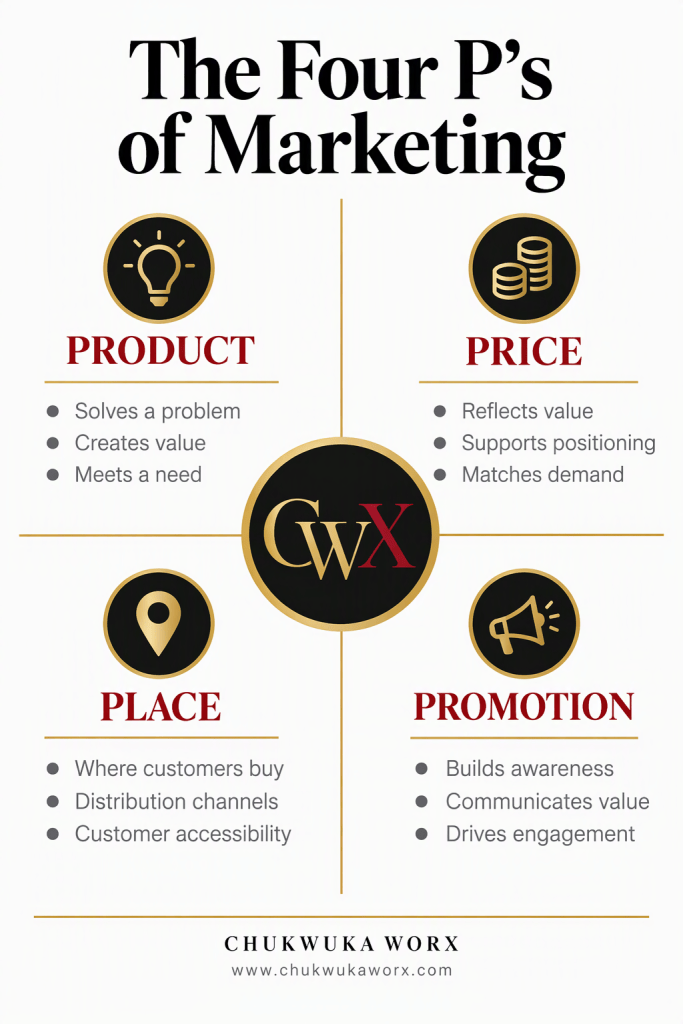
The Four P’s of Marketing
When people think of marketing, they often picture social media posts, advertisements, or catchy slogans (my husband thinks Mad Men). While those elements certainly play a role, effective marketing begins with a deeper strategic framework known as the Four P’s of Marketing.
Originally introduced by marketing professor E. Jerome McCarthy, the Four P’s help businesses determine how to position their products and services in a way that meets customer needs while creating a competitive advantage.
Whether you’re launching a new business, introducing a service, or refining your brand strategy, understanding the Four P’s can help you make more intentional and profitable marketing decisions.
1.) Product: What Are You Offering?
The product is the foundation of your marketing strategy. It represents the solution you provide to a customer’s problem, desire, or need.
A product can be a physical item, a professional service, a digital product, or even a personal brand. Successful businesses focus not only on what they sell but also on the value and outcomes they deliver.
Ask yourself:
■ What problem does my product solve?
■ What makes it different from alternatives?
■ What benefits matter most to my target audience?
For example, a coffee shop doesn’t just sell coffee. It may provide convenience for commuters, a gathering space for the community, or a premium experience for coffee enthusiasts.
Understanding your product’s unique value proposition is the first step toward building a strong market position.
2.) Price: What Is It Worth to Your Customer?
Pricing is more than assigning a dollar amount to your product or service. It communicates value and influences how customers perceive your brand.
Price should reflect factors such as:
■ Customer expectations
■ Competitive offerings
■ Operating costs
■ Brand positioning
■ Market demand
A premium brand may intentionally charge higher prices to reinforce exclusivity and expertise. Conversely, a business pursuing a high-volume strategy may compete on affordability.
The goal is to find a pricing strategy that aligns with both your business objectives and your customers’ perception of value.
3.) Place: Where Will Customers Access Your Offering?
Place refers to the channels and locations through which customers discover, purchase, or experience your product.
In today’s marketplace, “place” extends far beyond a physical storefront. It includes:
■ Websites and online stores
■ Social media platforms
■ Email marketing channels
■ Retail locations
■ Networking events
The most effective businesses make it easy for customers to engage with their offerings where those customers already spend their time.
A great product offered at the wrong place can struggle to gain traction, while a strategically placed offering can significantly increase visibility and sales.
4.) Promotion: How Will People Learn About It?
Promotion encompasses the communication strategies used to attract, educate, and persuade potential customers.
Promotional activities may include:
■ Content marketing
■ Social media campaigns
■ Email marketing
■ Public relations
■ Paid advertising
■ Community engagement
■ Referral programs
Many business owners mistakenly believe promotion is the most important element of marketing. In reality, promotion is only effective when it supports a well-defined product, price, and placement strategy.
The best promotional efforts amplify an existing strategy rather than compensate for a weak one.
How the Four P’s Work Together
One of the biggest misconceptions about marketing is that these elements operate independently. In reality, the Four P’s function as an interconnected system.
Consider a premium consulting firm:
■ Product: High-touch strategic consulting
■ Price: Premium rates that reflect expertise
■ Place: Professional website, networking events, and referral channels
■ Promotion: Thought leadership content and educational workshops
Each element reinforces the others to create a consistent market position.
If the same consulting firm charged premium prices but used discount-focused advertising, the strategy would send conflicting messages and potentially weaken customer trust.
Consistency across all four areas creates clarity, and clarity helps customers make purchasing decisions with confidence.
Revisit the Four P’s Regularly
Markets evolve. Customer expectations shift. New competitors emerge. Businesses that periodically evaluate their Four P’s are better equipped to identify opportunities, adapt their strategies, and maintain relevance.
Before investing in a new marketing campaign, ask yourself:
■ Is my product still aligned with customer needs?
■ Does my pricing reflect the value I provide?
■ Am I reaching customers through the right channels?
■ Are my promotional efforts supporting a clear business objective?
The answers often reveal opportunities for growth that go far beyond simply increasing marketing activity.
In Conclusion
The Four P’s of Marketing remain one of the most valuable frameworks in business because they encourage strategic thinking before tactical execution. When product, price, place, and promotion work together, businesses create stronger customer experiences, clearer positioning, and more sustainable growth.
Marketing isn’t simply about getting attention. It’s about creating the right offering, delivering it through the right channels, at the right price, and communicating its value to the right audience.
At Chukwuka WorX LLC, we believe that successful marketing starts with strategy. The Four P’s provide a powerful foundation for building a brand that attracts customers, strengthens loyalty, and supports long-term business growth.
#Marketing #BusinessStrategy #FourPs #Entrapreneur #SmallBusiness #Growth #Sales #ChukwukaWorX #BonnieChukwuka #RichlandWA #Solopreneur #FractionalBusiness #Startup


For more marketing tips from Chukwuka WorX LLC:


Leave a Reply