
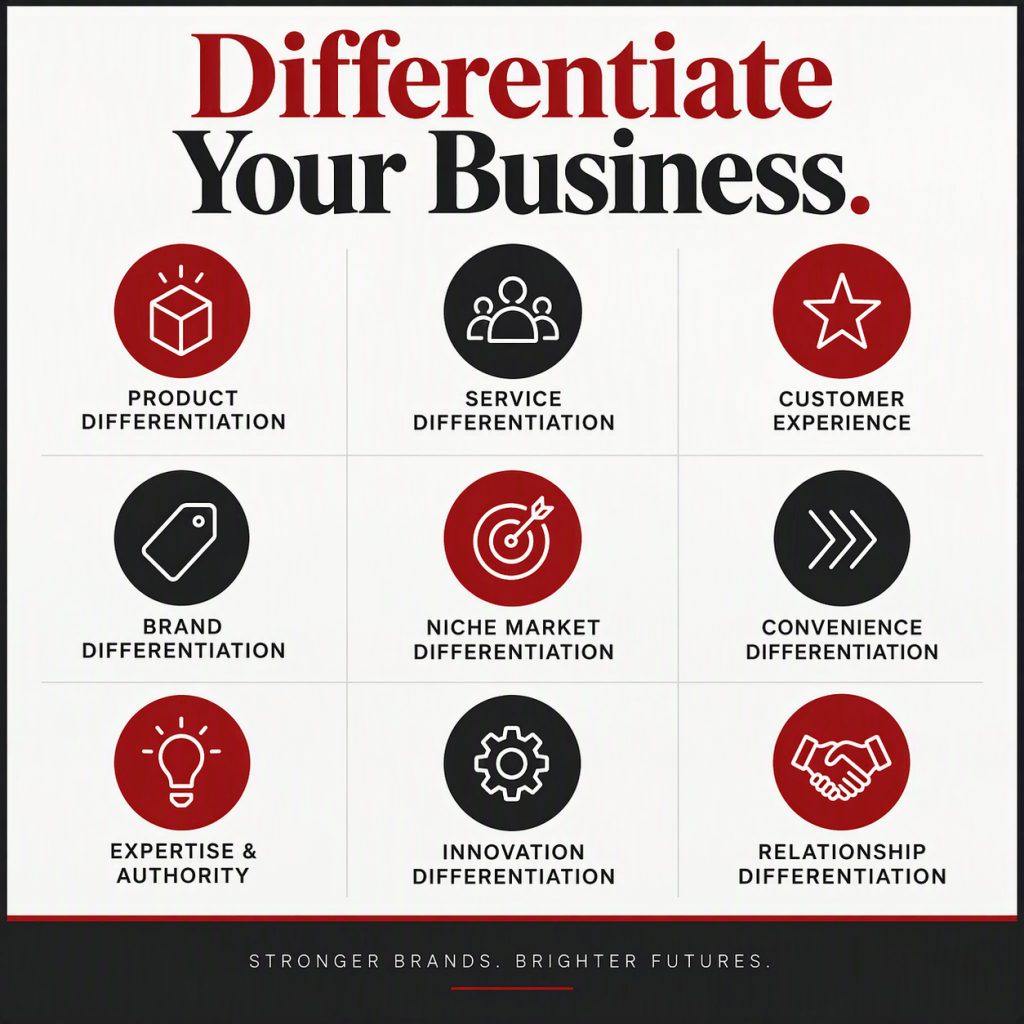
Stand out in a Crowded Market
In a competitive business environment, simply offering a good product or service is rarely enough. Customers have more choices than ever before, and businesses that fail to distinguish themselves often find themselves competing solely on price.
Successful companies understand that differentiation is not just a marketing tactic. It’s a strategic decision that creates meaningful value for customers and establishes a sustainable competitive advantage.
What Is Business Differentiation?
Business differentiation is the process of making your company, products, or services distinct from its competitors in ways that customers value. Effective differentiation gives customers a compelling reason to choose your business rather than simply selecting the lowest-priced option.
A good first step is to conduct a S.W.O.T Analysis (see earlier article) to determine existing strengths and weaknesses and compare to market research on your competitors to determine how similar businesses are positioned. Identify gaps in the current market and develop your product or business to fill the need. This competitive analysis helps businesses identify a sustainable competitive edge and create market advantages that support long-term growth.
1. Product Differentiation
One of the most common forms of differentiation is creating a product that offers unique features, superior quality, improved performance, or innovative functionality.
Examples include:
- Proprietary technology
- Higher-quality materials
- Unique design
- Enhanced durability
- Specialized functionality
Many premium brands succeed because customers perceive their products as offering benefits that competitors cannot easily replicate.
Best For
- Manufacturing companies
- Technology businesses
- Consumer products
- Specialty retailers
Key Question
What can your product do that competitors cannot match?
2. Service Differentiation
Outstanding customer service can become a powerful competitive advantage, especially in industries where products are similar. Service differentiation may include:
- Faster response times
- Personalized support
- Easier returns
- Dedicated account managers
- Extended service hours
- Proactive customer communication
Exceptional customer experiences reflect an organization-wide commitment and requires cross-functional collaboration.
Best For
- Service businesses
- Professional services firms
- Contractors
- Healthcare providers
- Local businesses
Key Question
How can we deliver a customer experience that competitors cannot easily duplicate?
3. Customer Experience Differentiation
Customer experience goes beyond customer service. It encompasses every interaction customers have with your business, from discovering your company to making purchases and receiving ongoing support.
Areas of customer experience differentiation include:
- Website usability
- Purchase simplicity
- Onboarding processes
- Communication quality
- Follow-up support
- Loyalty programs
Each time our customer encounters our brand is a part of their experience. A positive experience contributes to brand perception. Customer experience management becomes the key driver of customer satisfaction, loyalty, and retention.
Best For
- E-commerce companies
- Subscription businesses
- Professional services
- Hospitality and tourism
Key Question
Where are customer frustrations occurring, and how can we eliminate them?
4. Brand Differentiation
Some businesses compete primarily through the identity and emotional connection they create with customers.
Brand differentiation focuses on:
- Mission and values
- Company story
- Reputation
- Community involvement
- Emotional positioning
- Visual identity
Customers often choose brands that align with their personal beliefs, lifestyles, or aspirations, even when competitors offer similar products.
Examples
- Sustainability-focused brands
- Community-centered businesses
- Luxury brands
- Purpose-driven organizations
Key Question
Why should customers emotionally connect with our business?
5. Niche Market Differentiation
Rather than serving everyone, many successful businesses focus on a specific customer segment and become the preferred solution for that audience. They specialize and serve a narrow market segment exceptionally well.
Examples include:
- Marketing agencies specializing in dentists
- Fitness programs for seniors
- Software designed for construction companies
- Retailers focused on outdoor enthusiasts
Best For
- Small businesses
- Startups
- Consultants
- Service providers
Key Question
Who is underserved in our market?
6. Convenience Differentiation
Customers increasingly value convenience as much as price. Businesses can differentiate by making purchases faster, easier, and less stressful through:
- Online scheduling
- Mobile ordering
- Faster delivery
- Simplified checkout
- Self-service options
- Flexible payment methods
Convenience for customers is a key component of creating compelling customer experiences.
Best For
- Retail businesses
- Service companies
- Healthcare providers
- Restaurants
- E-commerce stores
Key Question
How can we save customers time and effort?
7. Expertise and Authority Differentiation
Businesses can establish competitive advantages by becoming recognized experts in their field. Methods include:
- Publishing educational content
- Speaking at industry events
- Sharing case studies
- Producing research
- Offering training programs
Customers are often willing to pay premium prices when they perceive a business as an industry leader.
Best For
- Consultants
- Agencies
- Lawyers
- Accountants
- Coaches
- B2B service providers
Key Question
How can we become the most trusted authority in our market?
8. Innovation Differentiation
Innovation-driven businesses continually create new value for customers through products, services, and business models.
Innovation may involve:
- New technologies
- Improved processes
- Unique delivery methods
- New customer experiences
- Industry disruption
This type of differentiation can create significant competitive advantages but requires ongoing investment and adaptation.
Best For
- Technology firms
- Product developers
- Startups
- Growth-focused companies
Key Question
What industry assumptions can we challenge?
9. Relationship Differentiation
People prefer doing business with companies they trust.
Relationship differentiation focuses on creating stronger connections through:
- Personalized communication
- Community engagement
- Long-term support
- Transparency
- Consistent follow-through
This strategy is particularly effective for local businesses and professional service providers.
Best For
- Real estate professionals
- Financial advisors
- Contractors
- Consultants
- Local businesses
Key Question
How can we build stronger relationships than our competitors?
Choosing the Right Differentiation Strategy
Many entrepreneurs make the mistake of trying to differentiate in every possible way. The strongest businesses typically focus on one or two core areas where they can consistently outperform competitors.
Start by evaluating:
- Customer needs and frustrations.
- Competitor strengths and weaknesses.
- Your company’s capabilities.
- Market opportunities.
- Long-term sustainability.
By combining market research and competitive self analysis, you will better identify unique opportunities and competitive advantages within your market.
In Conclusion
Differentiation is ultimately about creating value that matters to customers. Whether through superior service, innovative products, specialized expertise, exceptional customer experiences, or a focused niche strategy, the goal is the same: provide a compelling reason for customers to choose your business over the alternatives.
For small businesses and entrepreneurs, differentiation is often the most effective path to sustainable growth. When customers clearly understand what makes your business unique, you move away from competing solely on price and begin building loyalty, trust, and long-term profitability. Contact Chukwuka WorX LLC for assistance in identifying, developing, and marketing your business differentiation strategy.
#Differentiation #Unique #ValueProposition #SmallBusiness #Entrepreneurs #Marketing #TriCitiesWA #BonnieChukwuka #ChukwukaWorX #WhatIsDifferentAboutYou #BeDifferent #BestBusiness


For more marketing tips from Chukwuka WorX LLC:


Leave a comment