
Segmentation & Customer Personas
As a small business owner it is unlikely you can afford to market to “everyone.” If you were to attempt it, you would waste a lot of resources marketing to people who have no interest in your product or service. So, you need to identify and focus your marketing efforts (and dollars) to individuals most likely to buy, return, and advocate for your brand.
That’s where customer segmentation and customer personas come in. They help founders stop guessing, start focusing, and build marketing that actually converts.
What is Segmentation?
Segmentation divides your audience into smaller groups based on shared traits so you can deliver more relevant marketing. This process provides a competitive advantage.
In 2026
• Segmented campaigns generated up to 77% of total marketing return on investment
• Shoppers are 73% more likely to buy when recommendations match their needs
• 64% of customers think brand messages are too generic, and 81% ignore them
• 20–30% of customers drive 70–80% of revenue, meaning founders must identify their highest‑value segments early
Segmentation helps you stop wasting time and money on audiences who will never convert and start focusing on the ones who will. Think about who you designed your product or service for. Who gets the most value from your business? Conduct market research to understand your buyers. Break down the commonalities between your customers to identify trends.
Segment By:
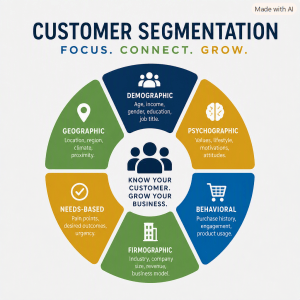
Demographics
Age, income, gender, education, job title. Useful for broad filtering and initial targeting. Example: A gym targeting women 25–44 with incomes above $60K.
Psychographics
Values, lifestyle, motivations, attitudes. This explains why people buy. Example: Two 35‑year‑old parents may buy differently based on whether they value convenience or price.
Behaviors
Purchase history, browsing behavior, email engagement, product usage. Most predictive of future action. Example: Customers who open every email should receive VIP offers.
Geography
Location, region, climate, proximity. Critical for local businesses, especially Tri‑Cities founders.
Firm (B2B)
Industry, company size, revenue, business model.
Technology (B2B)
Tools, platforms, software stack. Useful for consultants, agencies, and service providers.
Needs
Pain points, desired outcomes, urgency. Often the most powerful for small businesses.
How to Build Segments That Actually Work
Most founders make one mistake: they create segments once and never update them. 2026 research shows segmentation must be dynamic, not static. Think how celebrities and influencers ‘re-invent’ their look, sound, and styles to stay relevent to their loyal (maturing) fanbase or to appeal to a new segment. All businesses need to keep a ‘finger on the pulse’ of society to anticipate and respond to the needs, moods, and shifts in the market.
1. Collect the Right Data
Start with the data you already have, your customer and sales information.
• Purchase history
• Website analytics
• Email engagement
• Customer interviews
• Social listening (tune in to what your customers are saying online, who are they following, what are they posting, liking, and searching for online – track trends)
• Customer relationship data and point of sales data can help you track your products’ life cycle and changes in customer preferences
2. Identify Patterns
Look for:
• Who buys most often?
• Who buys at the highest price?
• Who engages with your content?
• Who refers others?
• Who buys once and disappears?
3. Prioritize High‑Value Segments
Because 20–30% of customers drive 70–80% of revenue, focus on the segments that deliver the most value.
4. Limit Yourself to 5–10 Segments
More than that leads to operational paralysis.
5. Refresh Segments Quarterly
Markets shift. Customer behavior changes. Your segmentation must evolve.
What is a Customer Persona?
A persona is a fictional but data‑driven representation of your ideal customer. It should feel like a real person you could meet at a Tri‑Cities coffee shop. Businesses often give their customer persona names to personalize to connect to them in a more meaningful way.
Once you have created very specific personas of your ideal customers, you can tailor your message, packaging, product, service, ads and access to that ‘person.’
Generic Example Customer Personas
Picture where and how you would approach these three different customers:
Persona 1: “Convenience‑Driven Parent”
• Segment Type: Psychographic + Behavioral
• Age: 30–45
• Motivation: Save time, reduce stress
• Behavior: Buys products that simplify life; responds to quick tips and how‑to videos
• Marketing Angle: Show how your product reduces friction and saves time
Persona 2: “Local Loyalist”
• Segment Type: Geographic + Needs‑Based
• Age: 25–60
• Motivation: Support local businesses
• Behavior: Shops within 10 miles; values community involvement
• Marketing Angle: Highlight local roots, community impact, and local testimonials
Persona 3: “Value‑Focused Researcher”
• Segment Type: Behavioral + Demographic
• Age: 35–55 • Motivation: Make informed decisions
• Behavior: Reads reviews, compares options, waits for deals
• Marketing Angle: Provide comparison charts, FAQs, and transparent pricing
Apply Segmentation & Personas in Your Marketing
Tailor Your Messaging
Speak differently to each persona’s motivations.
Customize Your Offers
VIP customers get early access; value‑focused customers get bundles.
Adjust Your Channels
• Local Loyalists → Facebook Groups
• Convenience Parents → Instagram Reels
• Researchers → Website content + email
Personalize Your Website
Behavioral segmentation lets you show different content to returning visitors.
Segment Your Email List
Email segmentation consistently outperforms batch‑and‑blast campaigns.
Refine Your Ads
Exclude loyal customers from acquisition ads to save budget.
Quick Comparison Table for Founders
| Segment Type | Best For | Data Source | Marketing Use |
|---|---|---|---|
| Demographic | Broad filtering | Census, CRM | Basic targeting |
| Psychographic | Messaging tone | Surveys, interviews | Emotional connection |
| Behavioral | Predicting action | Analytics, POS | Triggered campaigns |
| Geographic | Local businesses | Maps, ZIP data | Local SEO, local ads |
| Firmographic | B2B targeting | Industry data | Positioning & pricing |
| Technographic | SaaS/consulting | Tech stack tools | Product fit |
| Needs‑Based | High‑value targeting | Interviews | Offer development |
In Conclusion
Segmentation is a profitability strategy.
When you identify your target customers clearly, build personas that feel real, and tailor your marketing to each group, you create:
• Higher engagement
• Higher conversion
• Higher retention
• Lower ad spend
• Stronger brand loyalty
Chukwuka WorX LLC can help your business identify their target customers and position themselves in the Tri‑Cities market. Email bonniechukwuka@chukwukaworx.com to schedule an initial conversation.
#Marketing #CustomerSegmenting #CustomerPersonas #CustomerDemographics #MarketSegmentation #TargetCustomers #FocusedMarketing #Entrepreneurs #SmallBusinesses #Solopreneur #BudgetMarketing


For more marketing tips from Chukwuka WorX LLC:
 Chukwuka WorX LLC
Leave a comment