
Founders, Use SWOT Analysis
Every new business begins with an idea, but ideas alone don’t create momentum. What truly moves a business forward is clarity. Clarity about what you offer, how you operate, and where you fit in the marketplace. One of the simplest and most powerful tools for gaining that clarity is a SWOT analysis.
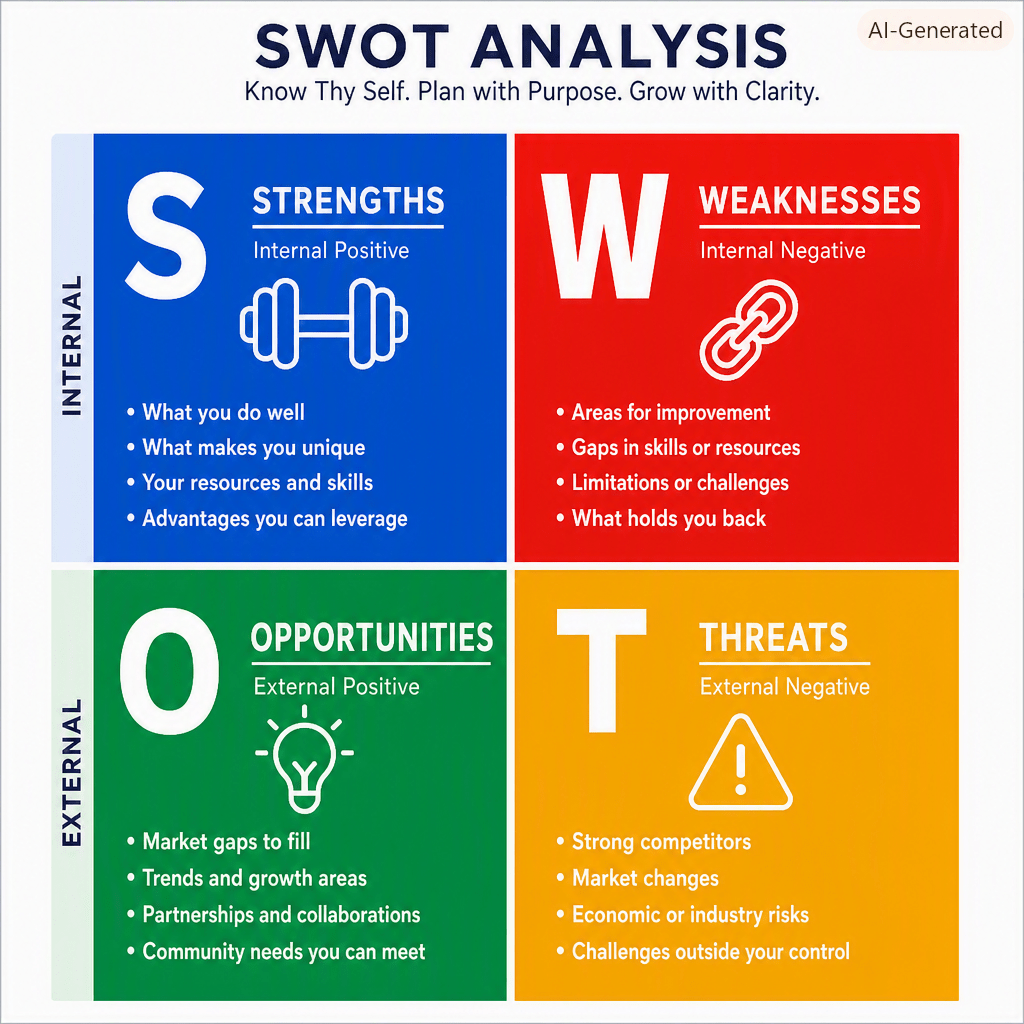
SWOT stands for Strengths, Weaknesses, Opportunities, and Threats. It’s a structured way for founders to understand themselves and their environment so they can make smarter decisions, build stronger brands, and position their business effectively.
Let’s look at what a SWOT analysis is, how it works, and how new businesses can use it to grow with intention.
Internal Factors: Strengths and Weaknesses
Strengths and weaknesses come from inside your business. They reflect your capabilities, your limitations, and the realities of how you operate.
Strengths
Strengths are the qualities that give your business an advantage. These may include:
- Skills you excel at
- Unique knowledge or experience
- Strong relationships or networks
- High-quality products or services
- A clear brand identity
- Efficient systems or processes
For new founders, strengths often come from personal background, education, personality, or past work experience. Identifying them helps you understand what you can confidently lead with in your marketing and branding.
Weaknesses
Weaknesses are areas where your business is limited or vulnerable. These may include:
- Gaps in experience
- Limited time or resources
- Inconsistent processes
- Lack of visibility or brand awareness
- Unclear messaging
- Difficulty with sales or pricing
Weaknesses are not failures. They are simply realities that need attention. When you acknowledge them early, you can plan around them, improve them, or find support to strengthen them.
External Factors: Opportunities and Threats
Opportunities and threats come from outside your business. They reflect the environment you’re operating in — your industry, your competitors, your local market, and your potential customers.
Opportunities
Opportunities are external conditions that can help your business grow. These may include:
- Gaps in the local market
- New trends or technologies
- Community needs
- Partnerships or collaborations
- Events, networking groups, or local business ecosystems
- Underserved customer segments
For new businesses, opportunities often show up as unmet needs. When you understand what your community lacks, you can position your business as the solution.
Threats
Threats are external challenges that could impact your business. These may include:
- Strong competitors
- Market saturation
- Economic changes
- Shifts in customer behavior
- Rising costs
- Regulatory changes
Threats help you anticipate obstacles so you can prepare for them instead of being surprised by them.
New Businesses Can Use SWOT Effectively
A SWOT analysis is most powerful when it becomes a decision-making tool, not just a worksheet. Here’s how new founders can use it strategically:
- Use your strengths as the foundation of your brand. Lead with what you do best. Build your messaging, visuals, and services around your strongest qualities.
- Address weaknesses with intention. Improve what you can, outsource what you can’t, and set realistic expectations for your capacity.
- Align your business with real opportunities. Look for gaps in your local market. Identify what people need but can’t find. Position yourself as the answer.
- Prepare for threats before they become problems. If you know what could impact your business, you can build systems, pricing, and strategies that protect you.
- Revisit your SWOT every quarter. As your business grows, your strengths evolve, your weaknesses shrink, and new opportunities emerge.
SWOT Positions Your Business in the Marketplace
Positioning is about how your business is perceived compared to others. A SWOT analysis helps you define your position by showing you:
- What makes you different
- What you can promise that others can’t
- Where your business fits in the community
- How you can stand out visually and verbally
- What customers should think of when they hear your name
When you understand your strengths and opportunities, you can craft a brand identity that feels authentic and relevant. When you understand your weaknesses and threats, you can avoid overpromising and build a brand that feels trustworthy and grounded.
Clarity is the foundation of your marketing strategy.
SWOT Applies to Marketing and Branding
Marketing and branding are not just about visuals or content. They are about communicating who you are and why you matter. SWOT gives you the raw material to build that message.
Here’s how it connects:
- Strengths become your value proposition.
- Weaknesses inform your tone, transparency, and growth plan.
- Opportunities shape your services, offers, and content strategy.
- Threats guide your pricing, positioning, and competitive approach.
A strong brand is built on self-awareness. When you know yourself, you can communicate with confidence, attract the right clients, and build a reputation that lasts.
In Conclusion
Every founder should complete a SWOT analysis within their first few months of business. It’s simple, honest, and incredibly effective. It helps you understand your identity, your environment, and your potential. Most importantly, it gives you the clarity you need to show up professionally and consistently.
If you’re a new founder who feels overwhelmed, unsure, or stuck, Chukwuka WorX LLC can help you complete a personalized SWOT analysis and turn it into a clear brand strategy, visual identity, and marketing plan. You don’t have to build your business alone. We are here to provide structure and support to make your vision a reality!
#Founder #NewBusiness #SWOT #SWOTAnalysis #Positioning #Marketing #Branding #Marketplace #ChukwukaWorX #BonnieChukwuka #KnowThySelf #SelfAssessment #BusinessGrowth #BizStrategy
For more Chukwuka WorX LLC marketing tips:
 Chukwuka WorX LLC
Leave a comment